

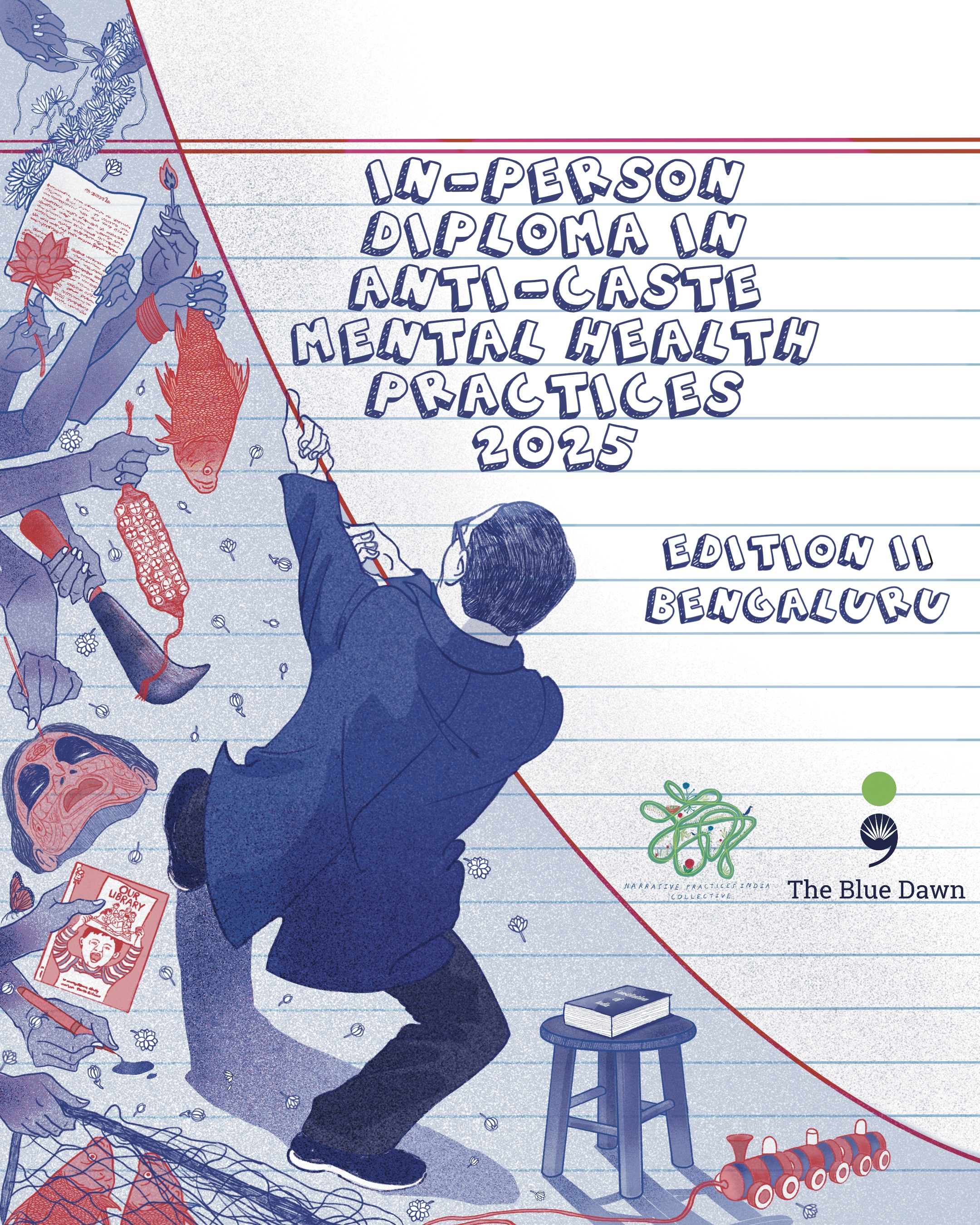
The Diploma in Anti-Caste Mental Health Practices is an 8-month in-person exploration based in Bengaluru starting June 2025. It is informed by Phule-Ambedkarite, Feminist, and Narrative practices and is a collaboration between The Blue Dawn and Narrative Practices India Collective.
The program addresses the omission of caste in mainstream mental health theory and practice and foregrounds anti-caste meaning-making as transformative practice.
The learning happens in person across 3 explorations over 8 months. Each exploration consists of 4 days of in-person training (approximately 8 hours per day) in Bengaluru.
In addition to the in-person explorations, there are online components including:
Exploration 1: 23–26 June 2025 (Mon–Thu)
Exploration 2: 11–14 August 2025 (Mon–Thu)
Exploration 3: 12–15 November 2025 (Wed–Sat)
Presentations & Graduation: 30 Jan – 1 Feb 2026 (online)
The diploma invites applications from community health workers, activists, teachers, counsellors, mental health professionals, writers, artists, social workers, occupational therapists, doctors, doctors in training, policy makers and others engaged in community and justice work.
Program Fee: INR 90,000 (non-refundable).
Multiple instalment options are offered:
Application Deadline: 28 April 2025.
Shortlisted applicants will be interviewed between 1–10 May 2025. Final enrolment confirmations will be communicated by 11 May 2025.
Scholarships are available specifically for participants from historically marginalised caste groups (SC, ST, OBC, NT, DNT, Indigenous/Adivasi).
We will be exploring maps to navigate through territories of life which are guided by these beliefs,Communities and people are experts of their own lives, who have know-hows and wisdom in responding to adversities which are stored in the stories of their lived experiences.
We are all making meaning of our experiences but this meaning making is influenced by the socio-cultural-historical-political intersections.
All the problems in this world are located in structural systems of oppression and not in communities and people’s bodies and identities.
We are all made of stories and stories is how we make sense of the world around us and ourselves. No story is fixed which means we can re-author them in our preferred ways.
Stories and identity construction is political because stories are advantaged and disadvantaged based on their gender, sexuality, skin color, caste, class, religion, region, ability, schooling, etc.
This exploration will happen through sharing and drawing on participants' and trainers’ lived experiences and emphasize on co-learning as peers and developing a community that co-travels together.
To complete the diploma participants will be expected to attend and participate in the training explorations and co-learning along with their assignment and the end of the diploma presentation sharing.To complete the diploma participants will be expected to attend and participate in the training explorations and co-learning along with their assignment and the end of the diploma presentation sharing.